Problems Plastic Pollution Creates for Wildlife in the Ocean
BY CHLOE WONG | EARTH.ORG | JAN 19TH 2022 | 4 MINS
Problems Plastic Pollution Creates for Wildlife in the Ocean
Plastic is part of everyday life, but waste that escapes collection can harm marine ecosystems and animals. This article, published in January 2022, examines ingestion, entanglement and ways to prevent plastic from reaching the sea. Its references to increased disposable masks and takeaway packaging relate to the COVID-19 pandemic.
—
How Serious is Plastic Pollution in the Ocean?
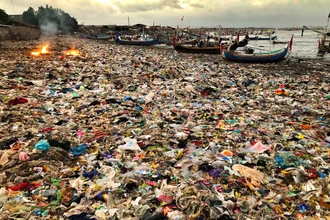
A model published in 2020 estimated that 11 million tonnes of plastic entered the ocean in 2016. This is an estimate of annual waste entering the sea, not a measured share of plastic manufactured in 2020. Production, waste generation and ocean leakage are different quantities and should not be equated.
A 2015 study estimated 15–51 trillion floating plastic particles, with a mass of 93,000–236,000 tonnes, for 2014. These modelled surface estimates do not include all plastic in the water column or seabed and do not mean that plastic covers 40% of the sea. Persistence varies by material and conditions; fragmentation is not the same as complete biodegradation.
Problems Plastic Pollution Creates for Wildlife in the Ocean
There have been a number of problems this rate of plastic pollution has created for wildlife in the ocean. Millions of animals are killed by plastics every year, from birds to fish to blue whales, often from eating and getting caught in plastic.
In 2019, a turtle hatchling, no bigger than the palm of a hand, was found dead with 104 pieces of plastic in its stomach.
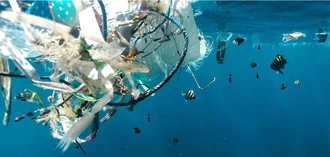
Animals easily mistake floating plastic garbage for food and consume them. In a new study, researchers found that the number of species contaminated with plastic has reached a new high. Alarmingly, they found that 1,557 species worldwide, including many endangered ones, have been documented to have ingested plastic. While in many cases, microplastic, which are tiny plastic particles that are less than five millimetres long, pass through animals’ digestive systems and are expelled without consequence, plastics have also been found to have blocked digestive tracts or pierced organs. Animals can choke, sustain internal injury and die – or starve by thinking they’re full from eating plastic. Plastic ingestion can also reduce the storage volume of the stomach, making it impossible for the animals to eat.
Plastic ingestion has been documented in many marine species. A 2015 seabird study projected that, if the modelled trend continued, it could affect 99% of seabird species by 2050. The figure concerns seabird species, not every individual bird, turtle or marine mammal, and is a projection rather than an observed outcome.
To make things worse, tests have confirmed plastic creates liver and cell damage and disruptions to reproductive systems, prompting some species, such as oysters, to produce fewer eggs. It means that the reproduction ability of the animals that survive and continue to consume plastics will fall as well, leading to a drop in the population of different species. Moreover, animals that ingest plastic will transfer the material up the food chain to bigger fish and marine mammals, harming and killing more and more animals in the process.
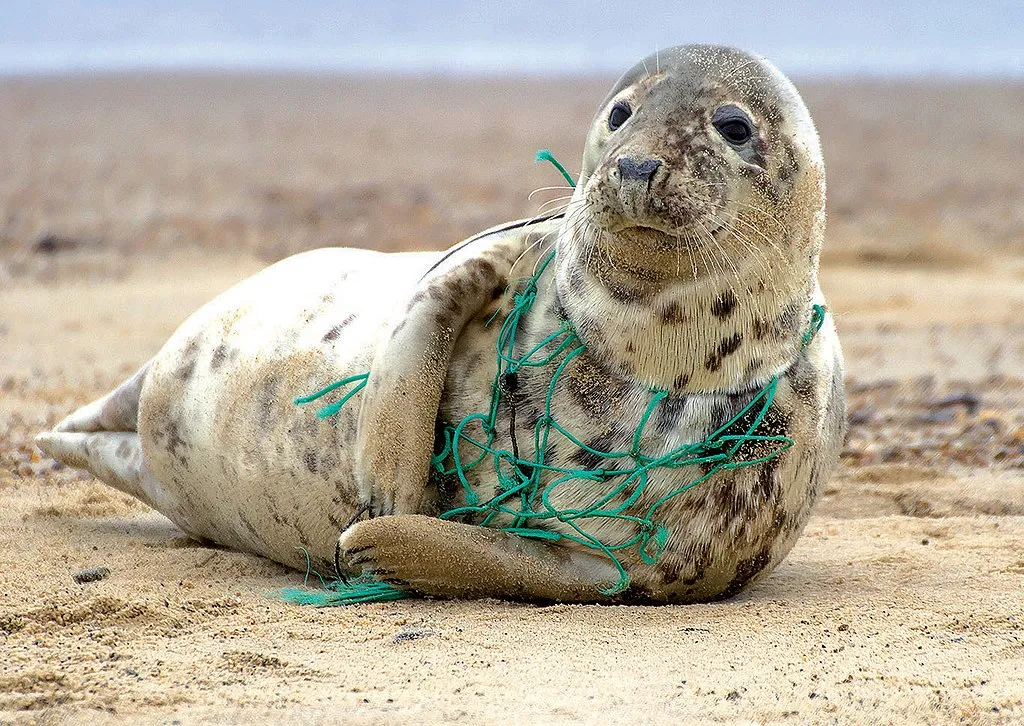
Aside from ingesting, marine mammals can also get tangled up in plastic. Large amounts of plastic debris have been found in the habitat of critically endangered Hawaiian monk seals, including in areas that serve as pup nurseries. Similarly, entanglement in plastic debris has led to a rise in injury and mortality rates in the endangered Steller sea lions, with packing bands the most common entangling material. Seals, whales, turtles, and other animals have also been found strangled by abandoned fishing gear.
People can also be exposed to microplastics through food, water and air. Finding particles in an animal or food does not, by itself, establish the dose people receive or the resulting health effect. WHO’s 2022 assessment identifies substantial evidence gaps; effects depend on particle characteristics and exposure. Harm observed in wildlife must not be presented as proof of the same harm in humans. (WHO, 2022)
What Can We Do?
It is near impossible for us to cut down our plastic usage to zero. However, simply reducing the amount of plastic we send for the landfill is essential in protecting the environment and wildlife. The 2021 World Economic Forum/Kearney report (Figure 7) compared reuse scenarios for 2030. In Scenario 1, a 10–20% reuse share by packaging sales unit corresponds to 7–13 million tonnes of plastic packaging shifted to reuse: 45–90% of the modelled annual plastic waste entering the ocean. The lower end is close to half that reference amount—not evidence of an actual halving of ocean pollution. In Scenario 3, a 40–70% reuse share corresponds to 26–46 million tonnes, equivalent to 185–320% of annual ocean plastic waste or 50–85% of annual landfilled plastic waste. These are mass comparisons with the report’s projected 2030 waste baselines, not achieved or forecast reductions in those waste streams. The conversion from sales units to mass assumes that the packaging shifted to reuse is representative of overall packaging weights.
Reducing plastic is much easier than you think; simply reusing and recycling plastic items such as bags and bottles can help keep plastic in use and divert suitable items from landfill, therefore lowering the risk of plastics leaking back into the ocean.
It may seem that these little acts make minimal effect on the vast world, but as long as you take the initiative to change your lifestyle little by little, you can already help countless animals. Your efforts can help alleviate the aforementioned problems plastic pollution creates for wildlife, and even improve the entire ecosystem.
Featured image by: Wikimedia Commons
This article originally appeared on Earth.Org and is republished here as part of an editorial agreement.
Explore more: