Closed-loop recycling: what polypropylene can still do after repeated processing
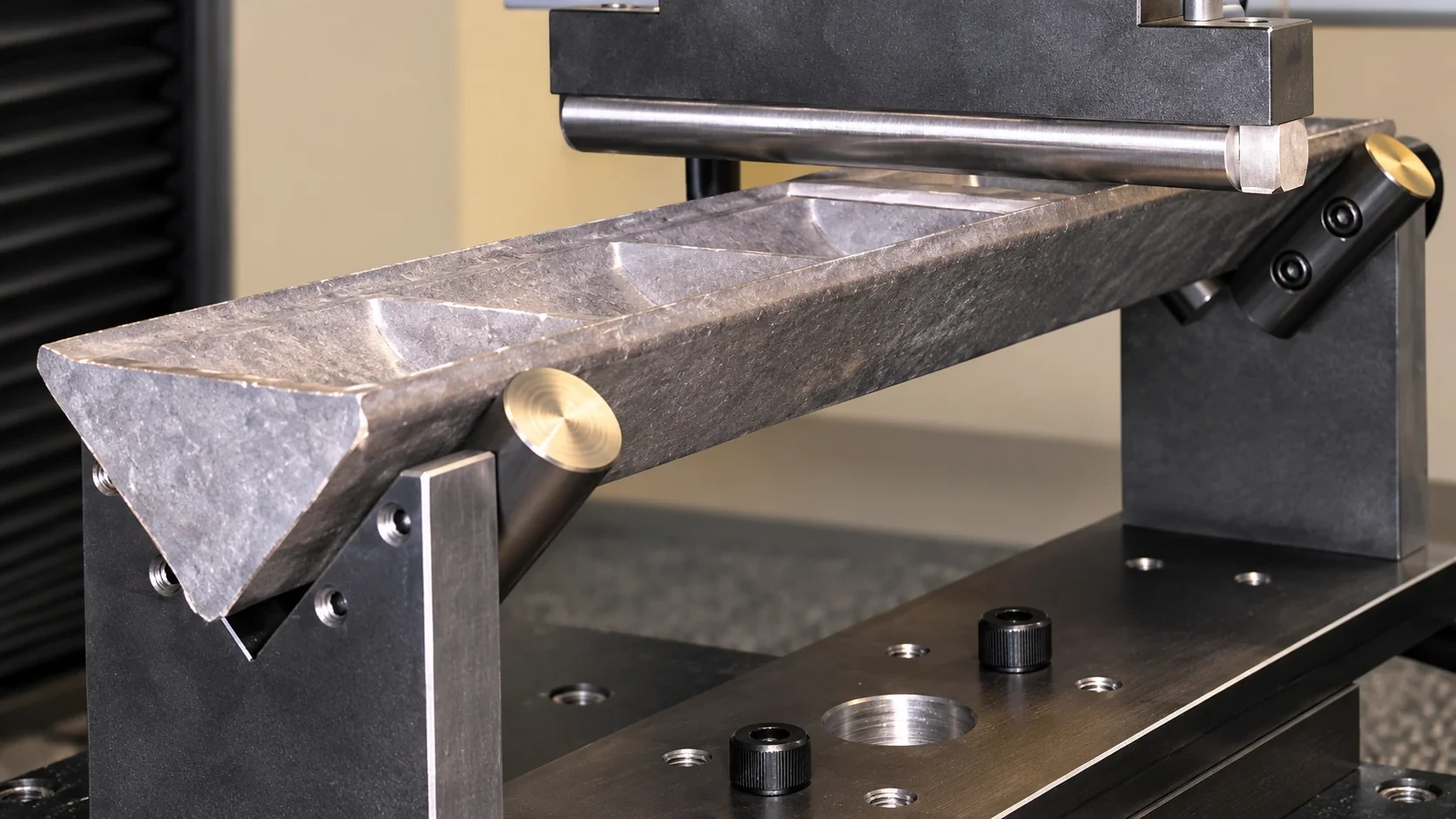
Three-point bending test. Source: SAMPE Europe 2025, Fig. 13, p. 9; attributed there to Severin Huber [SH-2024].
Making a part, grinding it and making a new part from the recovered material: that is a closed recycling loop in a laboratory. But what happens when the process is repeated? Is a material still suitable simply because it can still be processed?
A study by the Institute for Materials Technology and Plastics Processing (IWK) at OST – Eastern Switzerland University of Applied Sciences explores these questions. Jasper Hollender and Josip Dubravac presented the findings in a technical article; Dubravac also discussed them at RAKUFO. Their practical value lies in the detail: some properties remain relatively stable, while others change considerably. [1, 2]
What “closed loop” means in this study
The researchers examined three polypropylene systems: a PP homopolymer, a PP copolymer and a commercial post-consumer recycled PP containing PE. After injection moulding, the specimens were ground and processed again, apart from samples retained for testing. Processing parameters were deliberately kept constant to help attribute changes to the material condition. [1]
The homopolymer was investigated through twelve recycling cycles; the other two systems through twenty. This controlled sequence represents repeated processing. It does not demonstrate twenty real product lifetimes involving use, contamination, collection and changing feedstock quality.
“Post-consumer” and “closed loop” also describe different things. The former describes the history of an incoming material; the latter, here, describes how its repeated processing is organised in the experiment. An industrial loop needs an understanding of both.
Easier flow can come with less elongation
All three materials became more fluid as the number of recycling cycles increased. The authors associate this with the degradation of long polymer chains and declining melt viscosity. That affects filling, pressure and metering behaviour during injection moulding. [1]
The tested PP homopolymer illustrates the difference particularly clearly: its yield stress decreased from 36.0 to 35.4 MPa in the reported comparison, while elongation at break halved from 20 to 10%. The MFI increased substantially. [1]
One plastic. Different changes.
Yield stress
Elongation at break
Substantial increase in MFI
Yield stress is the stress at the transition to permanent deformation. Elongation at break describes how far a tensile specimen stretches before breaking. MFI measures the mass of melt flowing under specified test conditions. These values answer different questions. A higher MFI does not automatically mean a better material; an almost unchanged yield stress does not mean all mechanical properties have been retained.
For product development, that distinction matters. Looking only at a well-preserved property can conceal a change that is decisive for the finished part.
Why the three PP systems respond differently
The tested copolymer was particularly sensitive to repeated processing. The PE-containing PCR-PP showed greater stability in several measured properties. This does not establish a universal ranking in which PCR is always better or copolymer is inherently worse. The findings apply to the tested materials and conditions. [1]
Test temperature also matters: the tested copolymer retained impact resistance at room temperature in several of the conditions examined, but showed a sharp decline in impact strength at −20 °C. Applications involving low temperatures therefore require testing at the intended service temperature. [1]
The authors also describe effects moving in different directions: the PCR-PP’s unnotched impact strength at room temperature increased. They suggest improved distribution or homogenisation of the material phases as a possible explanation. Other properties can decline at the same time. Material assessment therefore needs to bring together several relevant measurements.
Appearance matters too. Colour and gloss changed with processing history. For a visible housing, this can be significant even when its mechanical function is still fulfilled. [1]
A practical example: what does this mean for a fastener?
A fastener must deform when it snaps into place and then hold securely. Depending on its application, it may need to do this repeatedly, at low temperatures or over extended periods. Stiffness alone cannot answer that requirement.
The IWK findings help frame the right questions: how much deformation must the part withstand? Which property limits its function? How sensitive is it to changes in processing history?
Elongation at break measured on a tensile specimen cannot be converted directly into a number of opening cycles. Approval requires tests on an appropriate prototype under agreed operating conditions. This fastener example is our application interpretation; it was not a test object in the IWK study.
- 01
Function
Define deformation and holding requirements.
- 02
Conditions
Specify temperature, loads and repeated use.
- 03
Testing
Test a suitable prototype, not only a datasheet value.
- 04
Decision
Approve the material and part together.
Stabilisation is an approach, not unlimited service life
The technical article and RAKUFO presentation also examine stabilisation using additives. The experiments indicate that selected properties and ageing behaviour can be influenced. The presentation compares samples with and without additives. [1, 2]
The technical article also reports internal preliminary trials: after five recycling cycles, suitable additives enabled property levels approaching those of the virgin material. The authors present this as a preliminary finding; the timing of addition, dosage and additive types remain under investigation. [1]
This is a useful development approach, but it does not mean all original properties are restored. Nor does an accelerated ageing test establish a fixed service life in actual use. Material system, stabilisation, processing and application need to be assessed together.
The presentation also considers energy optimisation. Energy demand, cycle time and quality are part of the same production decision. An individually optimised setting cannot establish whether the overall process is suitable for a particular application. [2]
What this means for dependable material loops
For Ocean Material, four practical questions follow: Where does the material come from? What processing has it undergone? Which properties does the next part require? How will compliance with those requirements be demonstrated?
These questions connect sourcing with development. Useful enquiries include the application, geometry, loads, environment and planned manufacturing process. On that basis, we support material selection and coordinate documentation and testing requirements with customers and partner manufacturers.
A closed material stream is a starting point. A technically dependable loop also needs evidence that the next part meets its requirements.
Connecting this with our development approach alongside MeSentia
The SAMPE Europe 2025 paper offers a complementary perspective. A case study involving MeSentia, Inspire and OST IWK investigated lightweight sandwich structures, including a demonstrator made from fully recycled natural-fibre-reinforced PP. For the tested configurations, the authors report comparable bending performance at lower weight than OSB references. [3]
For our development approach, this connects material testing with component design. It is a different investigation: the IWK findings on repeated injection moulding do not establish how many recycling cycles are possible with the process we are pursuing with MeSentia. Ocean Material is not an author of these studies.
Discuss your material or component requirements with Ocean Material.
Sources and context
[1] Jasper Hollender, Josip Dubravac (OST IWK): Abbauverhalten beim wiederholten Spritzgiessen. KunststoffXtra, 27 April 2026. Supplied PDF, pp. 1–9. Our chart uses the published values, not our own raw measurements.
[2] Josip Dubravac (OST IWK): Nachhaltiges Spritzgiessen: Energieoptimierung und Recyclingkreisläufe für eine ressourcenschonende Produktion. 21st RAKUFO, 3 September 2026, particularly slides 17 and 20–24. The presentation and article address the same research programme; they are not two independent confirmation studies. The documents do not identify Ocean Material or MeSentia as suppliers of the tested PP materials.
[3] Florian Langenegger, Markus Zogg (Inspire AG), Yanick Hauser, Gion Andrea Barandun (OST IWK): Lightweight Structures with High Recycled Material Content Made by Hot-Cold Flow-Press-Forming. SAMPE Europe Conference 2025, Amsterdam, section 4.2, pp. 10–12. Title photograph: Fig. 13, p. 9, from a separate case study; its source [SH-2024]: Severin Huber, Optimierung einer Leichtbaustruktur, semester thesis, ETH Zurich, autumn semester 2024.