Seaweed packaging: what is possible today?
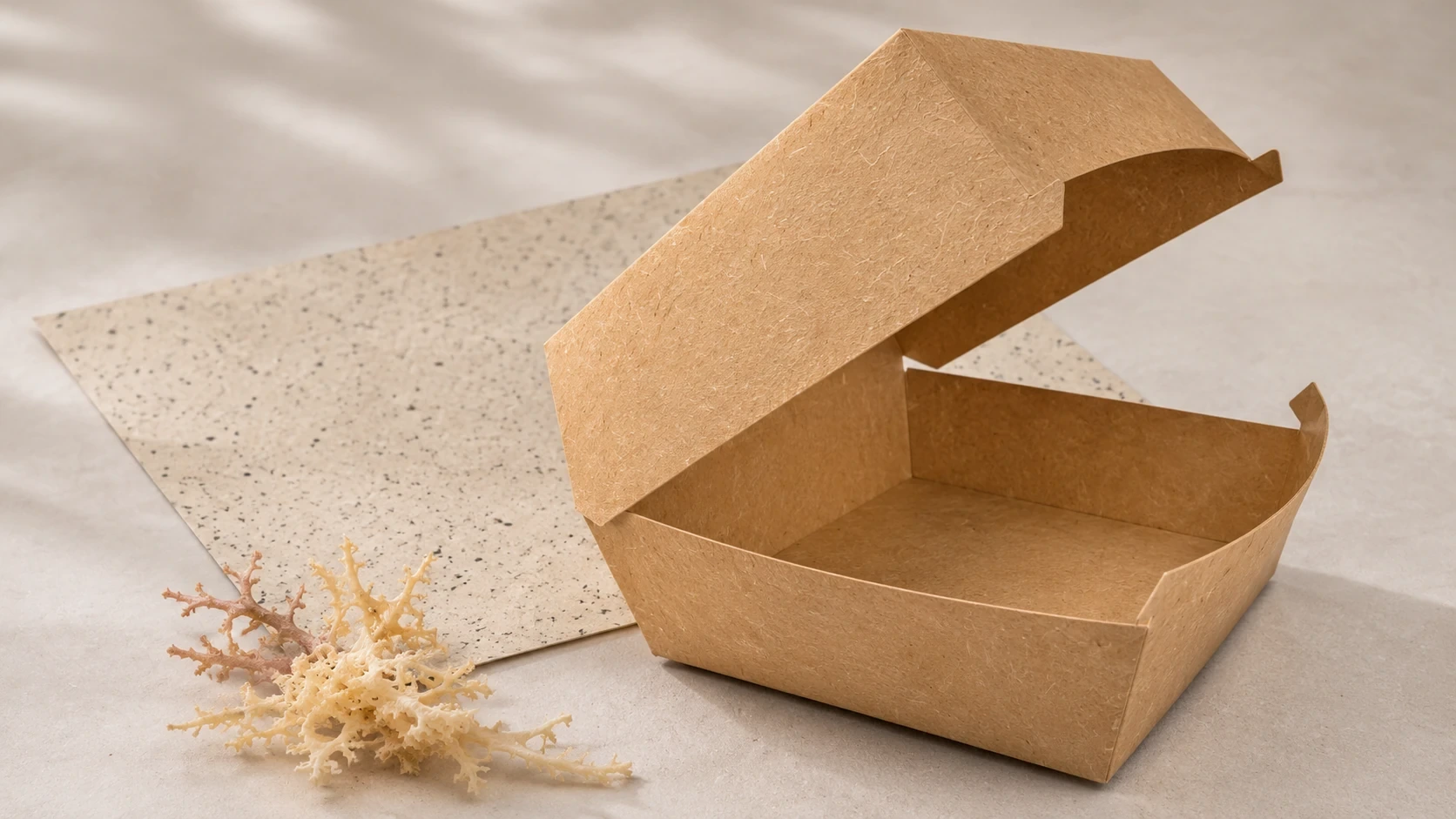
Cover illustration based on Ocean Material samples.
A window lets shoppers see the chocolates inside a carton. A coating keeps grease from soaking into a paper pack. In a sheet of seaweed paper, speckles become part of the design. Each uses seaweed in a different way.
Some seaweed packaging applications are already on the market. Others are taking shape as samples. Choosing between them starts with the product. What does it need protection from, for how long, and what happens to the packaging after use?
What does “seaweed packaging” mean?
Seaweed provides natural polymers that can be used to make films and coatings. Another approach incorporates seaweed into paper during papermaking. The formulation determines whether the result is a transparent film, a flexible coating or a sheet with a visible texture.
The seaweed component can serve a single purpose within a pack. In a windowed paper bag it can form the window. In coated board it can form a protective surface. In seaweed paper it becomes part of the sheet itself.
Three ways to use seaweed in packaging
1. Windows and flexible films
A window lets people see what they are buying, from chocolates to gifts. Seaweed-based films are being developed for these windows, as well as for wraps and bags.
For a converter, clarity is only the starting point. How does the film bond to the paper? Will it hold up when the pack is folded and shipped? How much moisture can it tolerate?
2. Coatings for paper and board
Paper gives a pack its shape and stiffness. A coating can add a specific protective property, such as resistance to grease, for suitable food packaging applications.
Ocean Material offers both a coating formulation for converters to apply and pre-coated kraft paper. The choice depends on the equipment and production process available.
3. Paper containing seaweed
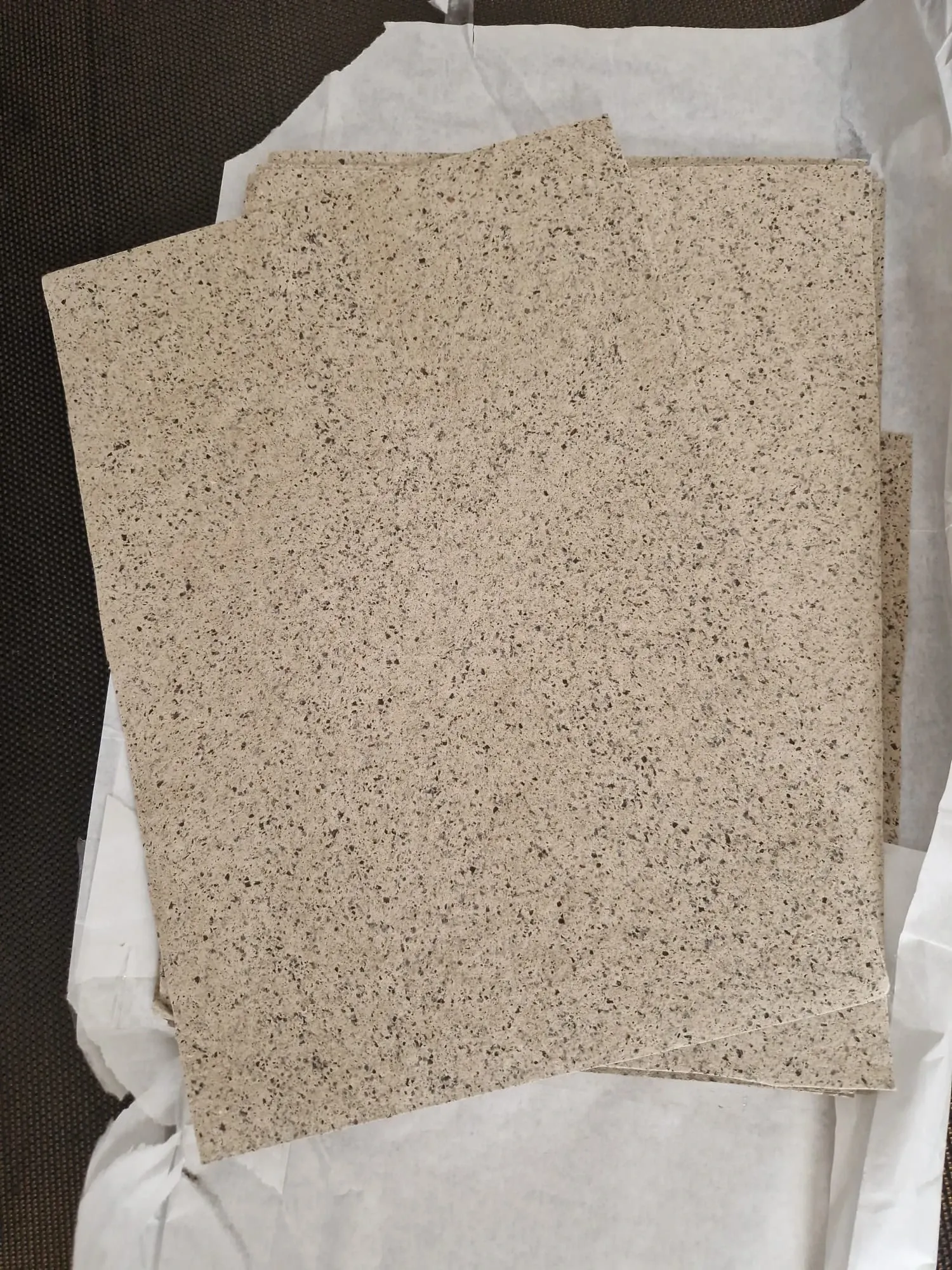
Seaweed can also be incorporated into the sheet during papermaking. Our seaweed paper has a pale natural colour and visible speckles that can become part of the design of a carton, a tag or printed material.
The paper mill requires a large minimum order to start a run. For now, this paper is a development option for larger projects. Brands and converters with sufficient combined demand can explore a production run together.
What a packaging window has to do
We have worked with packaging converters on a range of samples using our seaweed materials, including burger boxes, chocolate cartons, sandwich packs and window envelopes. Some of the packaging developed through these projects is already in retail use.
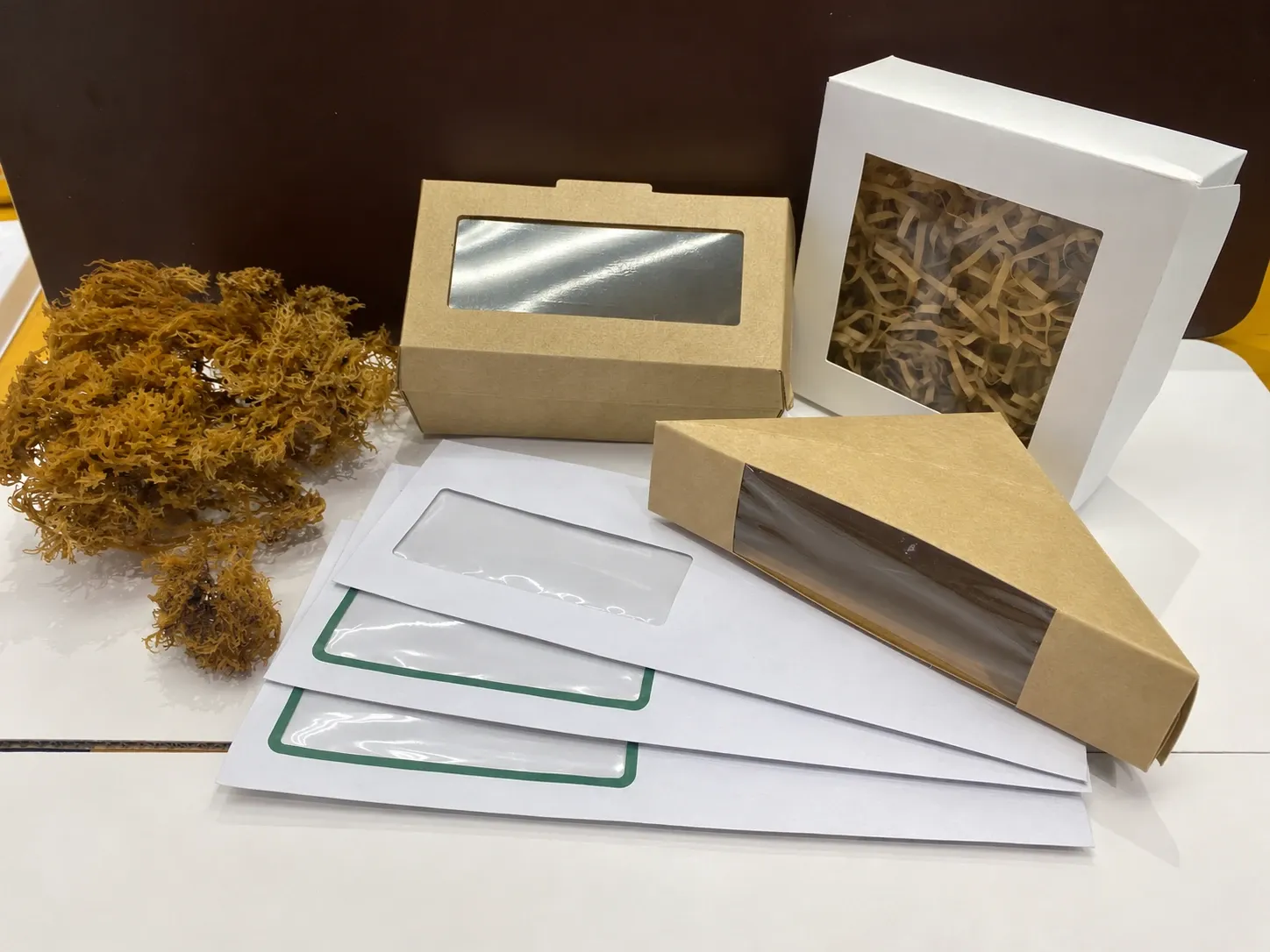
The film has to withstand cutting, gluing, folding and transport. For food packs, product protection and the intended food contact also matter. For an envelope, the address must remain legible and the window must stay in place through the post.
How seaweed films respond to water
Many film-forming substances derived from seaweed, including alginates, are hydrophilic. They attract or absorb water. Moisture can change how a film feels, its strength and which substances pass through it.
How a film behaves in water depends on its formulation, the bonds between its polymer chains, the arrangement of its layers and the conditions of use. Researchers vary these parameters when developing new films.
S3 · S4A pack for dry goods, a tray holding moist food and a cup of hot coffee each present a different challenge. The expected moisture exposure helps determine which material to test.
Grease, water vapour and oxygen need different barriers
A barrier slows the passage of a particular substance. Different tests tell us how well the packaging performs against each one.
| Barrier | Function | Question for the pack designer |
|---|---|---|
| Grease and oil | Limits grease penetration or staining. | Will the paper resist grease from this food? |
| Liquid water | Limits wetting or penetration on direct contact. | Will it hold for the required time and temperature? |
| Water vapour | Slows the exchange of moisture with the air. | Will the contents stay within the required humidity range during storage and transport? |
| Oxygen | Restricts oxygen transmission. | Will the product have enough protection over its intended shelf life? |
One study of calcium alginate composite films found promising oxygen barrier properties in the tested formulation. The researchers considered it best suited to low-moisture environments.
S4A grease-resistant wrapper can suit a fatty, mostly dry food. A hot drink brings sustained contact with liquid and heat, which calls for a separate assessment.
In a windowed pack, the window area, paper, adhesive and closure all contribute to protection. Compare barrier measurements under similar conditions and test the assembled pack.
Combining functions in a single pack
Paper provides stiffness. One layer may protect against grease, while another slows moisture transfer or allows the pack to be sealed. A single formulation can sometimes perform more than one of these functions.
Complementary layers offer a development route for seaweed packaging. The coating sequence, adhesion to the substrate and ability to fold or seal the pack have to work together. The order depends on the materials and the application.
The aim is to achieve the required protection with the simplest workable construction and to consider recovery after use. Each additional layer needs a clear purpose.
What determines the cost per pack?
The price per kilogram of coating tells a buyer only part of the story. How much coating does each pack need? For a water-based formulation, the solids content tells you how much dry material remains once the water has evaporated.
Coat weight, the number of passes, drying and line speed all affect cost. So does waste, including material lost in processing and packs that fail to meet the specification.
The figure to compare is the cost of a finished pack that delivers the required protection. Material developers and converters can assess these trade-offs early in a project.
S9Why seaweed is of interest as a raw material
Seaweed grown at sea supplies renewable biomass without using farmland or freshwater irrigation during cultivation. Sourcing and processing are part of assessing a responsible supply chain.
An environmental comparison follows the full route from cultivation or harvesting through drying, processing, other ingredients, transport and end of use. It also needs to account for the packaging’s ability to protect its contents.
S5Ocean Material designs the seaweed materials described here for home composting. We also consider what might happen if a material escapes into the environment. Our development goal is for it to biodegrade without causing harm under those circumstances.
What other uses does a raw material already have?
By-products of processing other crops are also candidates for bio-based packaging. Some already have established uses. Brewers’ spent grain, for example, is used in animal feed and biogas production. A fair assessment considers its source, existing uses and the processing required.
S8Some of these by-products can meet demanding purity and consistency requirements after processing. Their suitability depends on whether they can deliver a reliable feedstock of the required quality.
From a material sample to a working pack
Ocean Material works with research and development partners and packaging converters around the world to bring seaweed-based materials into packaging applications.
We help partners select materials, evaluate samples, coordinate conversion and develop a suitable supply chain. The work connects what a brand needs with what a converter can make.
The starting points are the product, the protection it needs and the expected order volume. These guide the choice of film or coating, the conversion process and the route to supply.
For more on processing seaweed directly, read Seaweed to polymer through extrusion.
If you are developing a new pack or considering a larger paper project, contact Ocean Material to discuss the construction and volume you have in mind.
Sources and further reading
- S3: Dysjaland et al. (2022), Molecules: alginate films containing seaweed powder
- S4: Mohammed et al. (2023), Food Hydrocolloids: calcium alginate composites for food packaging
- S5: European Commission: bio-based, biodegradable and compostable plastics
- S8: RISE: brewers’ spent grain as a food ingredient
- S9: Wolf Heilmann: Drying of Barrier Coatings
- S11: German Federal Environment Ministry: what belongs in the organic waste bin?
- S12: Cepi: Recyclability Laboratory Test Method for Paper and Board, version 3 (2025)
Frequently asked questions about seaweed packaging
Is the entire pack made from seaweed?
The seaweed content depends on the construction and formulation. In a windowed paper bag, the film may contain seaweed-derived ingredients while the paper, adhesive and other components have their own compositions.
Direct link to this answerCan seaweed coatings be used for hot drinks?
That depends on the coating and the cup. A hot drink needs a liquid barrier throughout use. A coating designed for greasy food needs separate tests for temperature, contact time and leak resistance before use in a hot drink cup.
Direct link to this answerCan seaweed pellets be used to make water-repellent packaging?
Yes, with a formulation suited to the application. Pellets are the form in which the material is supplied. How well the finished pack repels water depends on its composition and construction. Many seaweed-derived polymers, including alginates, absorb moisture. If the pack will be in prolonged contact with water, it may need a second material or a protective outer layer. Another bio-based material may be a simpler choice for that use. Seaweed-based materials are particularly useful when paper needs to resist grease or a film needs to limit oxygen exposure for a dry product. The choice of material depends on whether the pack needs to withstand splashes, hold hot water or keep grease from soaking through paper.
Direct link to this answerCan you eat seaweed packaging?
Only products developed and sold specifically as edible are suitable for eating. A seaweed-based packaging film or coating can contain other ingredients and may have been designed solely to protect the contents.
Direct link to this answerWhat happens to a seaweed coating during paper recycling?
When board is pulped in water, the paper fibres separate. The fate of the coating depends on its formulation and the finished construction. Laboratory testing can examine screen rejects, material carried into the process water and the quality of sheets made from the recovered fibres.
Direct link to this answerDoes mixing seaweed paper with recovered paper affect sheet quality?
The effect of our paper sample on a recovered-paper blend is still an open question. Comparing the same blend with and without the sample would show how fibre yield, visible particles and sheet adhesion change. The speckles in the original sheet do not tell us how the recycled sheet will turn out.
Direct link to this answerAre Ocean Material’s seaweed materials designed for home composting?
Ocean Material designs the seaweed materials described here for home composting. In a finished pack, paper, adhesives and other components also matter. Local collection rules determine what a municipal organic waste service accepts.
Direct link to this answerWhat needs to be checked before a pack is used with food?
The finished construction must suit the food and its conditions of use. Fat and moisture content, temperature, contact time and film processing all matter. The food-contact documentation and protective performance are assessed for that application. A material assessment alone does not cover every finished pack.
Direct link to this answerIs the seaweed paper shown here available to order?
The sheets are development samples. The paper mill requires a sufficiently large order before it can start production. Ocean Material is discussing potential demand with interested brands and converters. Pre-coated kraft paper is a separate material with its own ordering conditions.
Direct link to this answerSources and further reading: Dysjaland et al. (2022), Molecules: alginate films containing seaweed powder · Mohammed et al. (2023), Food Hydrocolloids: calcium alginate composites for food packaging · European Commission: bio-based, biodegradable and compostable plastics · German Federal Environment Ministry: what belongs in the organic waste bin? · Cepi: Recyclability Laboratory Test Method for Paper and Board, version 3 (2025) · Seaweed to polymer through extrusion